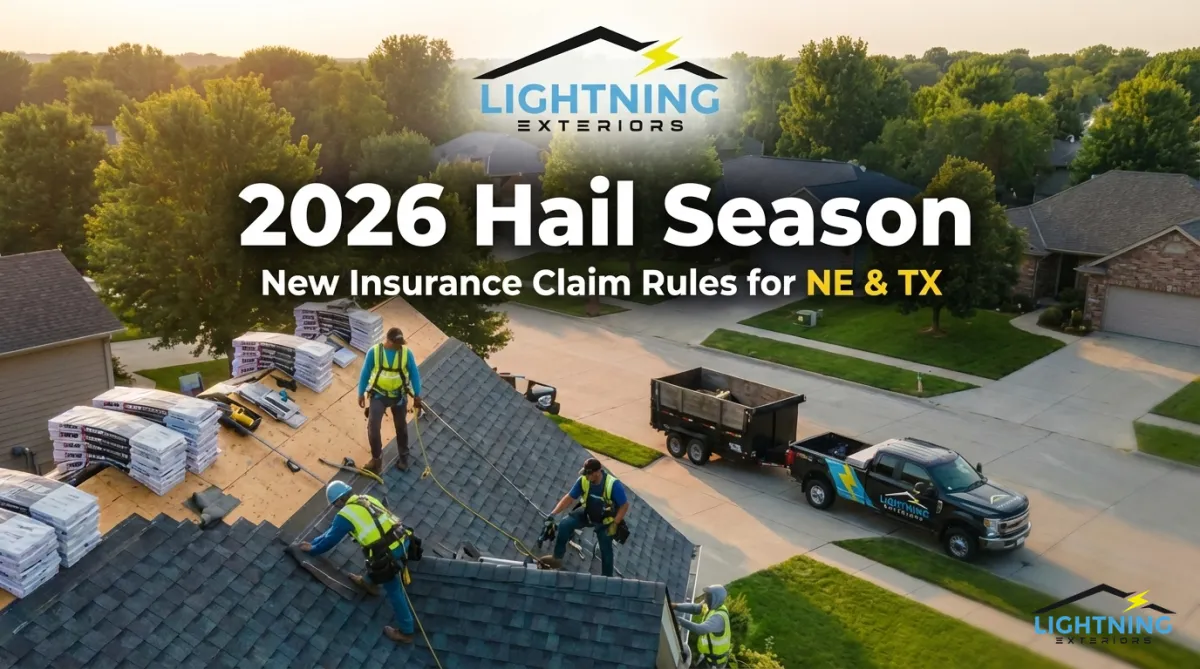
2026 Hail Season: New Insurance Claim Rules for NE & TX
2026 Hail Season: New Insurance Claim Rules for NE & TX
As we approach the 2026 hail season, homeowners in Nebraska and Texas are facing the most significant regulatory overhaul in a decade. Recent legislative sessions in both states have fundamentally altered how roof damage is reported, how claims are settled, and who can represent your interests during a dispute. Understanding these "2026 Hail Season: New Insurance Claim Rules for NE & TX" is no longer optional; it is a financial necessity for anyone looking to protect their property investment from the volatile weather patterns of the Great Plains and the Gulf Coast region.
Direct Answer: The new insurance claim rules for the 2026 hail season center on mandatory appraisal clauses (Texas SB 458), the elimination of Assignment of Benefits (Nebraska LB 1137), and a standard shift toward 2% wind/hail deductibles. Property owners must now navigate stricter timelines for filing disputes and more rigorous "matching" regulations for siding and roofing, particularly in Nebraska, while Texas residents benefit from new transparency requirements regarding policy cancellations and zip-code level reporting.
1. Introduction: Why 2026 is a Landmark Year for Hail Claims in NE & TX
The 2026 hail season is not just another year of storm tracking; it represents a "great reset" in the relationship between policyholders, insurance carriers, and restoration contractors. For years, Nebraska and Texas have served as the epicenter of hail-related insurance losses, leading to skyrocketing premiums and a flurry of legislative activity aimed at stabilizing the market. The 2026 rules are the culmination of several years of lobbying and legal challenges, resulting in a landscape that prioritizes transparency but places a higher burden of proof and financial responsibility on the homeowner.
In Nebraska, the focus has shifted toward consumer protection and the elimination of predatory "storm chasing" tactics. Legislators have recognized that while homeowners need help navigating claims, the previous system allowed for too much ambiguity in repair contracts. Meanwhile, in Texas, the emphasis is on streamlining the dispute process and preventing the courts from being overwhelmed by hail-related litigation. Both states are moving toward a model that favors mediation and appraisal over lawsuits, which can drastically change the timeline of a claim recovery.
Lightning Exteriors has monitored these changes closely to ensure our clients are never caught off guard. Whether you are dealing with a historic home in Omaha or a sprawling commercial property in Dallas, the 2026 rules will dictate your out-of-pocket costs and your ability to achieve a full restoration. This guide serves as the definitive resource for navigating these complexities, ensuring you have the knowledge to advocate for your home effectively when the first sirens sound this spring.
2. The 2026 Legislative Landscape: Key Bills and Effective Dates
To understand the 2026 hail season, one must first look at the specific bills that have shaped current policy. In Texas, the most impactful legislation includes Senate Bill (SB) 458, House Bill (HB) 2067, and SB 1644. These laws collectively address how disputes are handled, how insurers report cancellations, and how credit scores impact your rates. Most of these provisions reached full implementation by late 2025, making the 2026 season the first true test of their efficacy in a high-volume storm environment.
Nebraska has followed a similar path with the passage of LB 1137 and LB 1138. These bills were designed to address the "Assignment of Benefits" (AOB) issue that had previously led to high costs and legal entanglements for homeowners. By banning AOB and introducing a mandatory 5-day cancellation window for repair contracts, Nebraska is attempting to return control to the policyholder. These laws also introduced new registration requirements for contractors, ensuring that only qualified, local experts are handling storm restoration work.
It is also critical to note that while these laws are state-level, their impact is felt differently depending on your specific carrier. National insurers are standardizing their policy language to reflect these changes across state lines where possible. This means that even if a specific Nebraska law doesn't apply to a Texas resident, the trend toward higher deductibles and stricter roof aging rules is a universal reality for the 2026 hail season. Staying informed on the effective dates of these provisions is the first step in avoiding a denied claim.
3. Texas-Specific Updates: SB 458, HB 2067, and SB 1644
Texas SB 458: The Mandatory Appraisal Mandate
Senate Bill 458 is perhaps the most significant change for Texas residents. It essentially codifies the use of the appraisal clause as the primary method for resolving "amount of loss" disputes. In the past, if an insurer offered $10,000 and the contractor estimated $20,000, the path to resolution was often murky and expensive. SB 458 ensures that once appraisal is invoked, both parties must adhere to a strict timeline to select appraisers and an umpire, moving the process along faster than the traditional court system.
HB 2067: Zip Code Transparency and Redlining Prevention
House Bill 2067 addresses a growing concern among Texas homeowners: geographic redlining. In the 2026 season, insurers are required to report policy cancellations and non-renewals at the zip-code level to the Texas Department of Insurance (TDI). This rule is designed to prevent insurers from arbitrarily pulling out of high-risk areas like North Texas without justification. For homeowners, this means more accountability and a clearer picture of why their rates might be surging compared to a neighboring city.
SB 1644: Credit-Based Re-Rating Requirements
SB 1644 introduces a requirement for insurers to re-rate a policyholder’s credit score at least every 36 months if requested. In the context of a hail claim, this is vital because a 2026 claim could trigger a review of your entire risk profile. If your credit has improved since you first took out the policy, you may be able to offset some of the rate hikes that typically follow a statewide catastrophic hail event. This law puts the power back into the consumer's hands to ensure their premiums are based on current, accurate data.
4. The Mandatory Appraisal Process: How to Dispute Low Payouts in Texas
The appraisal process is often misunderstood by homeowners, but in 2026, it is the most powerful tool in your arsenal. Appraisal is a contractual right found in almost all Texas homeowners policies that allows for an independent evaluation of the damage when the insurer and the homeowner cannot agree on the cost of repairs. Unlike a lawsuit, appraisal does not determine *if* something is covered—only *how much* the covered damage costs to fix. This distinction is crucial because it avoids the need for a jury to decide technical construction costs.
The 2026 rules have introduced the "1-Year Appraisal Trap." Under proposed TDI rules and recent policy amendments, many insurers are now attempting to limit the window to invoke appraisal to just one year from the date the claim was partially accepted. This means if you spend 13 months arguing with an adjuster about the cost of a roof, you may lose your right to use the appraisal process entirely. Lightning Exteriors recommends invoking appraisal early—typically within 90 days of a stalled negotiation—to ensure your rights are protected.
When appraisal is triggered, you hire an appraiser, the insurance company hires an appraiser, and these two select an impartial "umpire." If the two appraisers agree on a number, that is the final settlement. If they don't, the umpire steps in to make a binding decision. For the 2026 hail season, this process is expected to be the standard way to handle the massive volume of claims efficiently. It is a faster, more technical, and often fairer way to reach a settlement than waiting years for a trial date.
5. Nebraska-Specific Updates: LB 1137 and the New Rules for Contractors
Nebraska LB 1137 has fundamentally changed how contractors operate during the 2026 hail season. One of the most significant changes is the mandatory 5-day cancellation window for any residential repair contract. This law allows homeowners to back out of a contract without penalty within five business days of signing if the work is being paid for via insurance proceeds. This "cooling-off period" is designed to protect residents from high-pressure sales tactics that often follow a major storm event.
Furthermore, LB 1137 explicitly prohibits contractors from "acting as an adjuster." This means a roofing contractor in Nebraska cannot negotiate the legalities of a policy on behalf of the homeowner. They can provide technical estimates and meet with adjusters to point out damage, but they cannot cross the line into public adjusting without a license. This creates a "Contractor Power Shift," forcing homeowners to decide early in the claim process whether they need a restoration expert (like Lightning Exteriors) or a licensed public adjuster to handle complex legal disputes.
Another critical component of LB 1137 is the prohibition on rebating or waiving deductibles. In the past, some unethical contractors would offer to "cover the deductible" to win a job. As of the 2026 season, this is a clear violation of Nebraska law and can lead to the contractor losing their registration and the homeowner potentially facing insurance fraud allegations. It is more important than ever to work with a reputable company that follows the law and helps you navigate the 2026 wind and hail deductibles legally.
6. The Death of AOB: Why You Can No Longer 'Assign' Your Claim in Nebraska
For years, "Assignment of Benefits" (AOB) was a common practice where a homeowner would sign over their insurance claim rights to a contractor. The contractor would then deal directly with the insurance company, and the homeowner would be removed from the equation. While this seemed convenient, it led to massive litigation spikes and often left homeowners in the dark about their own claims. For the 2026 hail season, Nebraska LB 1137 has effectively killed AOB for residential roofing claims.
Now, the claim stays in the name of the policyholder. Payments are typically made via multi-party checks that include both the homeowner and the mortgage company. This shift ensures that the homeowner maintains control over the funds and the quality of the work. It also prevents "storm chasing" companies from filing lawsuits against insurers in the homeowner's name without their direct knowledge. This change requires the homeowner to be more engaged in the process, but it ultimately provides a much higher level of financial security.
Without AOB, the role of the contractor has evolved into a partnership. At Lightning Exteriors, we view this as a positive development. It allows us to work transparently with you, providing the documentation and evidence you need to secure a fair payout while ensuring you remain the ultimate decision-maker for your property. The 2026 rules ensure that the person with the most to lose—the homeowner—is the one who remains in charge of the claim.
7. Policy Trends: 2% Deductibles and the 10-Year Roof Rule
One of the most painful trends for the 2026 hail season is the standardization of the 2% wind and hail deductible. Previously, many homeowners enjoyed a flat $1,000 or $2,500 deductible. Today, insurers are moving toward a percentage of the home's insured value. For a home insured for $500,000, a 2% deductible means the homeowner must pay $10,000 out of pocket before the insurance coverage kicks in. This shift makes small "cosmetic" claims almost impossible to file, as the damage often falls below the deductible amount.
Additionally, insurers are increasingly enforcing the "10-Year Roof Rule." If your roof is more than 10 or 15 years old, many policies now automatically transition from Replacement Cost Value (RCV) to Actual Cash Value (ACV). RCV pays what it costs to replace the roof today; ACV pays a depreciated value based on the age of the materials. In 2026, filing a hail claim on a 12-year-old roof might only result in a check for 40% of the replacement cost, leaving the homeowner to cover the remaining 60% plus their 2% deductible.
Payout Basis Current market price for new materials Depreciated value based on age Out-of-Pocket Just your deductible Deductible + Depreciation gap Common Age Limit Usually roofs under 10-15 years Standard for roofs 15+ years8. The 'Matching' Rule: Getting a Full Roof in Nebraska vs. Patchwork in Texas
The concept of "matching" is one of the most contentious issues in 2026 hail claims. In Nebraska, homeowners benefit from a "uniform appearance" rule. This regulation generally mandates that if an insurer replaces damaged shingles or siding, the new materials must match the existing ones. If a specific shingle color is discontinued and a repair would result in a mismatched, "patchwork" look, the insurer may be required to replace the entire roof or all the siding to maintain a uniform appearance. This is a massive win for Nebraska homeowners seeking to preserve their property value.
Texas, conversely, often relies on "like kind and quality" language, which is far more restrictive. Texas insurers frequently argue that if they can find a shingle that is functionally similar, they are not obligated to replace the entire slope just because of a slight color variation. This can lead to "patchwork" roofs that hurt curb appeal. For the 2026 hail season, Texas homeowners need to look for specific "matching endorsements" in their policies, which can be added for a small fee to override this default patchwork rule.
Technical breakdowns of these rules show that Nebraska's regulation overrides common "stingy" policy language found in national carrier contracts. However, the burden remains on the contractor to prove that a match is unavailable. At Lightning Exteriors, we use digital color matching and manufacturer databases to document discontinued items, providing the evidence needed to trigger a full replacement under Nebraska's uniform appearance guidelines.
9. Consumer Rights: Getting Automatic Written Reasons for Cancellations
One of the most significant consumer wins for the 2026 season involves transparency in policy management. Under new rules in both Nebraska and Texas, insurers can no longer simply send a "notice of non-renewal" without a detailed, written explanation. In the past, homeowners would find themselves dropped after a single hail claim with no recourse. Now, the insurer must provide the specific underwriting criteria used to make that decision, allowing the homeowner to dispute inaccuracies.
This is particularly important in Texas under HB 2067. If an insurer cancels your policy, they must disclose if the cancellation is due to state-wide risk shifts or specific property issues. If the reason is a roof that the insurer deems "beyond its useful life," you now have the right to provide an inspection from a licensed contractor like Lightning Exteriors to prove the roof is still functional. This transparency prevents "blanket" cancellations that often occur after a particularly bad hail year.
Furthermore, these rules protect your CLUE (Comprehensive Loss Underwriting Exchange) report. In the 2026 hail season, if a claim is filed but $0 is paid out (common with the new 2% deductibles), you have the right to ensure that the report reflects a "closed without payment" status rather than a "loss history" event that could raise your rates elsewhere. Knowledge of these rights is the best defense against the administrative hurdles of the modern insurance industry.
10. Sovereign Immunity and Elderly Protection: Unique 2026 Clauses
The 2026 rules also include niche protections that are rarely discussed in general guides. In Texas, SB 593 provides a unique layer of protection regarding "Sovereign Immunity Claims." While rare, this protects homeowners from rate hikes for claims caused by government actions (such as damage from a city-owned tree or utility failure during a storm). While hail is an act of God, many storm events involve secondary damage caused by infrastructure failure. SB 593 ensures you aren't penalized for the government's shortcomings.
In Nebraska, LB 1138 introduces enhanced fraud protection for senior homeowners. This law recognizes that elderly residents are often targeted by fraudulent contractors following catastrophic loss events. It mandates clearer disclosure requirements in contracts and provides state-funded resources for seniors to verify the registration of any contractor who knocks on their door. This is an essential protection for Omaha's aging population, ensuring they aren't taken advantage of during the stress of a hail disaster.
These clauses reflect a broader movement toward ethical restoration. At Lightning Exteriors, we pride ourselves on transparency, but we recognize that not every company shares our values. Whether it's protecting a senior's savings or ensuring a Texas homeowner isn't unfairly rated for a city error, these 2026 rules represent a significant step forward in consumer equity. Understanding these unique angles can save you thousands of dollars in hidden costs and premiums.
11. Practical Prep: A 2026 Homeowners Checklist Before the First Storm
Preparation is the key to surviving the 2026 hail season. You should not wait until the first golf-ball-sized hailstone hits your roof to learn what is in your policy. The new rules favor those who are proactive and documented. Follow this checklist to ensure you are ready for whatever the 2026 weather brings to Nebraska or Texas:
- Audit Your Deductible: Check if you have a flat rate or a 1% or 2% deductible. Calculate the exact dollar amount so you aren't shocked by the bill.
- Verify RCV vs. ACV: Call your agent and ask: "Is my roof currently covered for Replacement Cost Value or Actual Cash Value?" If it's ACV, ask what the cost would be to upgrade.
- Get a "Pre-Storm" Inspection: Have Lightning Exteriors perform a FREE roof inspection now. Having date-stamped photos of a healthy roof *before* a storm is the single best piece of evidence in a dispute.
- Check for the "Matching Endorsement": Especially in Texas, verify if you have coverage that ensures a uniform appearance for siding and roofing repairs.
- Document Your Interior: Hail often leads to water intrusion. Take a video of your ceilings and attic now to prove that any future leaks are new damage.
- Know Your Contractor: Ensure your preferred contractor is registered in Nebraska or licensed appropriately in Texas. Save our number (Lightning Exteriors) in your phone now.
12. Conclusion: Navigating the 2026 Hail Season with Confidence
The 2026 hail season brings a complex web of new insurance claim rules for NE & TX, but it also brings a new level of clarity. While deductibles are rising and timelines are tightening, the elimination of AOB and the implementation of mandatory appraisal processes provide a more structured path to recovery. By staying informed on legislative changes like Texas SB 458 and Nebraska LB 1137, you can navigate the aftermath of a storm with confidence rather than confusion.
Remember, the insurance company has experts on their side—you should have them on yours as well. Partnering with a professional roofing contractor like Lightning Exteriors ensures that your damage is documented with precision, your repairs are handled with care, and your claim is processed according to the latest 2026 standards. Don't let the new rules leave you with a patchwork roof or an empty bank account. Prepare now, and you'll be ready for whatever the clouds bring this year.
Ready to Get Started?
Lightning Exteriors offers a comprehensive range of exterior services including roofing, siding, and gutters, delivering exceptional results through expert craftsmanship and a commitment to customer satisfaction.
Visit Our Homepage


